Showing posts with label Consumer Credit. Show all posts

Consumer Credit Serve as the Next Economic Aftershock to Further Fuel the Financial Crisis?

Tuesday, December 21, 2010

But with so many Americans already losing their main source of income – their jobs – at an ever-spiraling rate, will an economy that derives two-thirds of its power from consumer spending end up mired in its worst funk in decades because those same consumers are now losing their charge accounts?
The U.S. economy weakened across all regions since the middle of October as it became tougher to get loans and demand for credit shrank, the U.S. Federal Reserve said in its regional economic survey report yesterday (Wednesday). The so-called “Beige Book” report – published just two weeks before central bank policymakers are to meet and consider interest-rate changes – said that retail sales, tourism spending and manufacturing declined in most places, labeled housing markets as “weak” and concluded that the commercial real estate sector “weakened broadly,” Bloomberg News reported.
We are looking at an economy that is not only in a recession, but a recession that is deepening rapidly,” former Fed Governor Lyle Gramley, now senior economic adviser at Stanford Group Co., told Bloomberg Television.
This economic one-two punch could generate a much-bigger financial crisis “aftershock” than many experts realize. Only two of the last 10 recessions to take place since the Great Depression have lasted a full year. But this one could last well into 2010. To fully understand the forces at play, let’s first look at the outlook for U.S. employment.


Non-farm payroll employment fell by 240,000 in October, and the unemployment rate jumped to 6.5%, up from 6.1% the month before, the Bureau of Labor Statistics reported in early November. October’s drop in payroll employment followed declines of 127,000 in August and 284,000 in September. That means that U.S. employment has fallen by 1.2 million jobs in the first 10 months of the year, with more than half of that decrease occurring in August, September and October. The government’s jobless numbers for November won’t be released until tomorrow (Friday) – although it’s expected to show that the U.S. economy lost jobs for the 11th straight month, Bloomberg News reported.
The ADP report prompted some analysts to boost their estimates for the job losses we’ll see in tomorrow’s Labor Department report. New predictions include a payroll decline of 400,000 from Goldman Sachs Group Inc. (GS) and a drop of 450,000 from Wachovia Corp. (WB) economists. And the unemployment rate for November probably spiked to 6.8%, the highest it’s been since 1993.
According to a number of estimates, the U.S employment outlook – and the overall economy – is going to get much worse before it gets better. Goldman Sachs Group Inc. (GS) says the U.S. unemployment rate will spike to 9.0% by the fourth quarter of 2009, as corporate profits plunge an estimated 25% – and that’s after an estimated decline in profits of about 10% this year, Goldman says. Indeed, the U.S. economy – as measured by gross domestic product (GDP) – will decline by 5.0% in the current quarter, followed by declines of 3.0% in the first quarter of 2009 and 1.0% in the second quarter, Goldman predicts.
The U.S. Commerce Department estimated that U.S. GDP rose 0.9% in the first quarter and 2.8% in the second quarter. For the third quarter, GDP declined an estimated 0.3%.
More than $2 trillion in consumer credit could be cut in the next 18 months, as credit-card companies pull back credit lines in anticipation of credit funding problems and regulatory changes, said Meredith Whitney, an Oppenheimer Holdings Inc. (OPY) banking analyst who’s well-known for her gutsy and prescient (and ultimately correct) market calls.
Throughout the week, Whitney has warned that the entire mortgage market will contract for the first time ever in the months ahead. More importantly, however, Whitney says the credit card market will be 18 months behind, as credit-card companies pull back more than $2 trillion in credit lines, taking away consumers’ second major source of liquidity, following jobs.
“What you haven’t seen yet digested by the market is banks pulling lines from consumers,” Whitney said in an interview with CNBC. “And across the board you saw the big banks that command so much of the market share of key products like mortgages and credit cards start to pull lines in the third quarter and that’s going to continue in the fourth quarter. And that’s going to continue into 2009.”
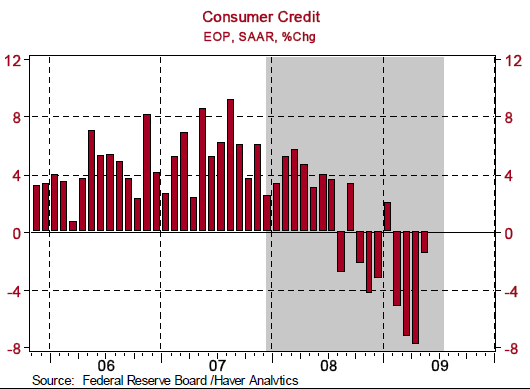
During dire times, many consumers can boost their use of credit even as they cut overall spending, using the credit cards, home-equity lines and other forms of borrowing as a lifeline to tide them over. For those consumers, a credit line cut can be disastrous personally, and can aggregate into an even-steeper downturn in spending.
Roughly 70% of U.S. households have access to credit cards, and 90% of those people use those credit cards as a cash-flow management vehicle, or revolve payments at least once a year, Whitney says.
A surprisingly small number of national companies dominate the major lending arteries – including credit lines, mortgages and credit cards – that have sustained the U.S. consumer for so long, including mortgages and credit cards. Mortgages have already hit a wall with the collapse of the U.S. housing market and wave of subprime defaults. But credit cards could be next as companies raise interest rates, tighten lending standards, cut credit lines, and even close millions of accounts in an effort to insulate themselves from consumer defaults.
“What is actually taking place is a shift in consumer psychology that has been driven by factors such as the socioeconomic climate – as well as the environment – and that’s now being compounded by credit conditions,” Gilani said. “This is about banks and credit companies de-leveraging and forcing the American consumer to do the same.”
The trouble is, he said, this can become a cycle that’s hard to stop once it takes hold.
“Whether Americans have lost confidence in the market or simply can’t afford to repay loans, money flows have simply dried up” Gilani said. “So banks have been forced to raise their lending standards to a point that many Americans are now unable to meet. It becomes a vicious cycle.”

The operation of the connected lender liability provision and deemed agency provision in Sections 56 & 75 of the Consumer Credit

Consumer credit
The person from whom we take or buy on credit could charge an interest for that. The Consumer Credit Act(CCA) 1974 was enacted so as to provide better protection to those who avail credit from the persons who are engaged in the business of providing credit facility to the consumer. The   CCA 1974 was enacted as per the recommendations of Lord Crowther committee on consumer credit, which started its working in 1968. The CCA 1974 came into force with such a big bang as one of the most modern and sophisticated enactment on credit or money lending system, however it took more than a decade to implement all its provision into force. A creditor is responsible for the acts or negotiation of the dealer or supplier who acts on his behalf in a regulated agreement. The creditor is equally responsible to the supplier or the dealer for any misrepresentation or breach of contract if there is a regulated credit agreement and the credit is granted under an agreement between the creditor and the supplier, in case of commercial transaction in which the amount ranges from £100 to £ 30000. Credit includes a cash loan and any other form of financial accommodations as defined under section 9 (1) of CCA 1974. In a credit transaction a creditor grants a right to debtor to defer payment of debt. Every form of agreement involving credit and loans had been brought into the parlance of the CCA 1974.
Bankruptcy filingsA consumer credit agreement, or consumer hire agreement, other than an exempt agreement, and “regulated” and “unregulated” agreements will come within the meaning of “regulated agreement.
A “debtor-creditor-supplier agreement” is a regulated consumer credit agreement a restricted-use credit agreement, or a restricted-use credit agreement which falls made by the creditor under pre-existing arrangements, or in contemplation of future arrangements, between himself and the supplier, or an unrestricted-use credit agreement which is made by the creditor under pre-existing arrangements between himself and the supplier other than the debtor in the knowledge that the credit is to be used to finance a transaction between the debtor and the supplier, as envisaged under Section 12 of CCA 1974. The funding agreement was not a credit agreement for the purposes of the Consumer Credit Act 1974 , nor was the relationship arising out of the agreement unfair and the creditors were not consumers for the purposes of the Unfair Terms in Consumer Contracts Regulations 1999 as held by Justice Andrew Smith of QB in Maple Leaf M VM Fund v.
A restricted-use credit agreement is a regulated consumer credit agreement, to finance a transaction between the debtor and the creditor, whether forming part of that agreement or not, or to finance a transaction between the debtor and   the supplier other than the creditor, or to refinance any existing indebtedness of the debtor's, whether to the creditor or another person. An unrestricted-use credit agreement is a regulated consumer credit agreement in which the credit is in fact provided in such a way as to leave the debtor free to use it as he chooses, even though, certain uses would contravene that or any other agreement. A running-account credit is a facility under a consumer credit agreement whereby the debtor is enabled to receive from time to time from the creditor or a third party cash, goods and services to an amount or value such that, taking into account payments made by or to the credit of the debtor.
He is liable to keep books or other records in the course of business along with the record that contains the details of persons with whom he does the business and those people who seeks to do business with him. A licence held by the creditor shall be terminated either by operation of law or if the Office of Fair Trading suspend the licence. The debtor is not liable to repay the credit if the person who gives a credit is disguised that he holds a licence or the existing licence had been terminated. The creditor shall   canvass or advertise regarding an offer of credit only in accordance with the regulations promulgated by the Office of Fair Trading from time to time, and the same should be with in the trade premises of the creditor. A credit token shall only be given who request for that. A duty is cast upon the creditor to display regarding the information about the business consumer credit in the premises in which he carryon the business of consumer credit as per section 53 of CCA 1974.
US bankruptcy filingsA  creditor or any person who negotiate for and on behalf of him with the debtor or hirer prior to the execution of the regulated agreement is termed as a negotiator and such negotiation is termed as an antecedent negotiation  as per section 56 (1) of CCA 1974. A negotiator other than the creditor or owner in relation to the making of the agreement is deemed  to be conducted such negotiation as an agent of the creditor and negotiated for and on behalf of the creditor as per section 56 (2) of CCA 1974. If in a regulated agreement or in a prospective regulated agreement the negotiator who acts for and behalf of creditor is named as an agent of the debtor or hirer the agreement will become void as per section 56 (3) of CCA 1974.
4 All E.R. 99, held while allowing the appeal, “ …..that the mere fact that the agreed value for the first car cancelled out the amount still outstanding upon it did not mean that there had been two transactions. Where goods which would be the subject of a debtor, creditor, supplier agreement, were sold or proposed to be sold by a broker, then any negotiations relating to those goods would be deemed to have been made by the negotiator on behalf of the creditor.
A jointly and severally liability is cast upon the creditor, to the debtor for any misrepresentation or breach of contract done by the supplier in connection with a debtor- creditor- supplier agreement, with respect to a commercial transaction.
The appellants / plaintiffs filed a suit against the creditors in pursuant to section 56 (2) and 75 of CCA 1974. The court held that the a cause of action will arose in UK, in the applicability of debtor- creditor supplier agreement, even if the subject matter is situated outside the territorial jurisdiction of UK courts. I can see no reason at all for supposing that parliament intended to enact in relation to the statutory cause of action conferred by section 75 (or section 56) any jurisdictional requirement to be observed in proceeding against the supplier. But I do not think that the answer to the question lies in the principles established by the European court of justice in the interpretation of the words.
The Office of Fair Trading brought proceedings seeking declarations in relation to certain issues concerning connected lender liability arising under section 75 (1) of CCA 1974, against a creditor,  in  Office of Faire Trading v Lloyds TSB Bank plc.
The creditor had to bring its commercial power to bear on the recalcitrant supplier to fulfil the debtor’s right in circumstances where the supplier was still in a position to provide a remedy. Section.75 of CCA 1974 provide useful security to debtors who would otherwise have suffered when namesake companies and paper companies went out of business, having failed to fulfil their commitments but having already grabbed the debtors money.

The dealer who sold the goods to the creditor under Section 56(1)(b) could be termed as  a credit-broker. However negotiations which are “antecedent” to the conclusion of the relevant agreement which apply to statutory agencies under section 56(1) (b) and (c). Section 69(6) provides that the dealer is the deemed agent and section 102 deals with notice of rescission where again the dealer is the deemed agent. Section 56(1) establishes a statutory agency for negotiations that are antecedent to the conclusion of the relevant agreement.